Kenpo Is My Base, Not My Boundary

I recently came across a discussion about why some Kenpo practitioners have chosen not to integrate judo, Brazilian jiu-jitsu, modern kickboxing, MMA or other combat-sport methods into what they do. The argument was essentially that martial arts should evolve, that we should learn from what happens when trained fighters actually fight other trained fighters, and that refusing to change in the face of better information is ultimately a choice.
On that basic proposition, I agree. We should cross-train. We should expose what we do to people who approach fighting differently from us, and we should be prepared to discover that some of the things we have been doing don't work as well as we thought they did. If somebody can consistently expose a hole in my martial arts, I don't want to invent an explanation for why the hole doesn't really matter. I want to fix it.
Where I differ slightly is in what comes next. I don't think the answer is simply to keep adding martial arts until you have accumulated enough techniques to cover every conceivable situation. I think you need a base: a coherent martial framework that you understand deeply enough to recognise what belongs within it, what needs to be modified and what simply doesn't fit. For me, that base is Kenpo.
Every martial art has blind spots
Every martial art has blind spots. That isn't an insult to any of them; it is simply the consequence of specialising in particular problems and developing particular methods of solving them. Taekwondo has developed extraordinary kicking skills, but if someone gets through that preferred range there are areas it does not explore nearly as deeply. Boxing has refined punching, movement, timing and defence to an extraordinary degree, but a boxer who has never trained against kicks, throws or grappling is dealing with problems the sport was never designed to solve.
I have trained Wing Chun, and there are aspects of its close-range hand fighting that I think are excellent. At the same time, its characteristic weighting towards the rear leg and the way its stance is structured can leave vulnerabilities against somebody aggressively driving forward or attacking your balance and base. That doesn't mean Wing Chun is useless. It means that a training method designed around particular assumptions will inevitably expose weaknesses when those assumptions change.
Brazilian jiu-jitsu provides an equally obvious example from the other end of the spectrum. BJJ is outstanding at solving the problem of controlling and submitting another person on the ground. If I am forced to grapple with somebody, I would much rather understand BJJ than not understand it. But if I am on the ground methodically improving my position against one person while his mate is standing beside us kicking me in the head, the tactical value of remaining on the ground changes very quickly. Again, that doesn't diminish BJJ. It simply reminds us that context matters.
Kenpo has its own blind spots and we should be equally willing to acknowledge them. Traditional American Kenpo does not have a sophisticated ground-fighting system. Nor does it develop throwing, gripping, off-balancing and resisting clinch work to the depth that judo does. Depending upon how a particular school trains, students may also have relatively little experience dealing with somebody who is continuously attacking them at full speed rather than providing the discrete attacks around which many traditional techniques are initially taught. Pretending those gaps don't exist doesn't preserve Kenpo. It simply prevents us from addressing them.
If somebody tells you their martial art has no weaknesses, that is probably when you should start questioning what they are telling you.
What MMA has taught us
MMA is perhaps the closest thing we currently have to an exception, but even there I think we need to be precise about what that means. Mixed martial arts has been extraordinarily effective at identifying what matters when one trained, unarmed person fights another trained, unarmed person. Over the past several decades, it has demonstrated very clearly that a fighter needs to be able to strike, defend strikes, grapple, defend takedowns, control position and survive when a fight moves between ranges. It has also been merciless in exposing techniques and assumptions that only work when the other person cooperates.
Traditional martial artists would be foolish to ignore what MMA has taught us.
But MMA is not really a martial art in the same sense as Kenpo, judo or karate. It is an amalgam of arts and training methods selected and refined for a particular purpose: defeating another trained fighter within the rules and environment of a combat sport. That environment necessarily shapes what develops. There is one opponent, a known start to the encounter, a defined fighting area, a referee and a rule set. Weapons are excluded, other people are not supposed to join the fight, and there is no tactical requirement to escape, protect somebody else or decide whether continuing the engagement is legally or practically sensible.
That isn't a criticism of MMA. In fact, those constraints are part of what make it such a valuable laboratory. They allow fighters to test skills against skilled resistance repeatedly without turning every contest into an uncontrolled life-and-death encounter. But they also mean that MMA has blind spots of its own. They are simply different blind spots.
The lesson I take from all of this is not that we need to find the martial art with no gaps. There isn't one. The lesson is that we need to understand where our own gaps are and deliberately expose ourselves to people who can help us fill them.
Cross-training is not collecting techniques
That is where cross-training becomes important, but I think there is a difference between cross-training and collecting techniques. It is easy to attend a few seminars, learn a judo throw, a BJJ submission, a Muay Thai elbow and a boxing combination, then convince yourself that you have integrated four different martial arts. You haven't. You have collected four techniques.
A judo throw exists within an entire system of posture, gripping, movement, kuzushi, entry and control. A boxing combination sits within a system of movement, defence, timing and recovery developed through thousands of rounds against people trying to hit back. A BJJ submission is normally the end result of a sequence of positional battles that somebody may spend years learning to understand. If we simply extract the visible technique without understanding the system that makes it work, we risk becoming a jack of all trades and master of none.
For me, that is why having a base matters.
Kenpo as a base
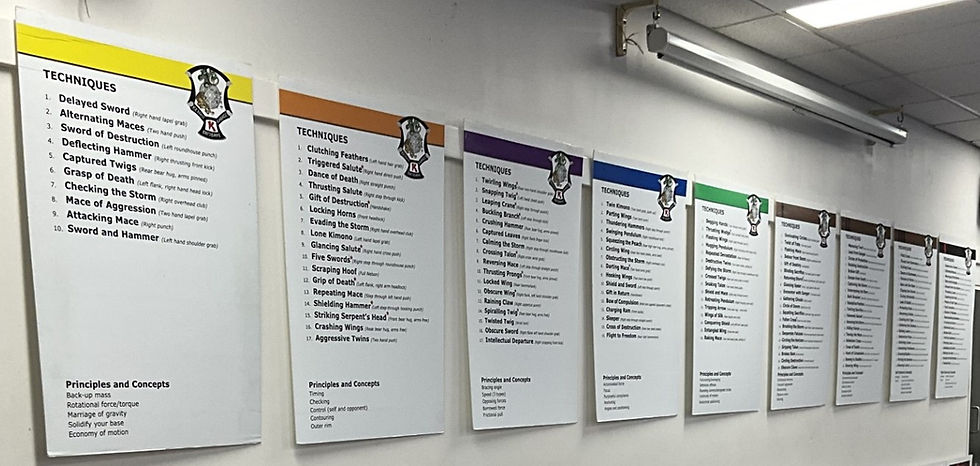
One of the great advantages Kenpo gives us is that Ed Parker did not leave us merely a collection of fighting techniques. He attempted to provide an intellectual framework for understanding them. Through the techniques, extensions, forms, principles, concepts and the material contained in Infinite Insights into Kenpo, we have access to a remarkably detailed attempt to explain why things work, how movements relate to one another and how the system can be analysed rather than simply imitated.
That does not mean Parker solved every problem. He plainly didn't. Nor do I think we need to pretend that Kenpo somehow already contains, hidden within its techniques, every answer that judo, boxing or BJJ has developed. The value of Kenpo as a base is not that it is complete. Its value is that it provides a coherent framework from which we can continue learning.
So if I go and train with judoka, the objective isn't simply to add three throws to my Kenpo syllabus. I want to understand what judo teaches me about balance, posture, gripping, movement, kuzushi and what happens when somebody who genuinely understands throwing starts trying to disrupt my base. When I return to Kenpo, I can then look at what I already do through a better-informed set of eyes. Does my stance survive that pressure? Do the assumptions within a particular technique still make sense? Am I actually controlling somebody's balance before attempting to throw or sweep them, or have I simply been relying on a cooperative partner? Is there something in Kenpo that I now understand differently because judo has shown me another way of looking at the problem?
The same applies to boxing. If somebody who spends thousands of hours punching people who punch back can show me that my defence is too static, that my combinations leave me exposed or that my understanding of range falls apart under pressure, I want to know that. I can then bring those lessons back to Kenpo rather than deciding that I am now also a boxer because I have learned a jab-cross-hook.
BJJ should challenge us in the same way. If someone can take me to the ground, control my hips, pass my legs and leave me unable to escape, that is information I need. Learning enough grappling to understand those positions changes the way I think about what happens after a Kenpo technique puts somebody on the ground, what happens when one of my own takedowns or throws fails, and what happens when I am the person who ends up underneath.
Bringing it back to the solidify my base
The process, then, is not simply to add. It is to leave the base, expose yourself to something different, discover what you don't know, learn from it and then bring that knowledge back. Sometimes that means changing what you do. Sometimes it means discovering that an existing Kenpo principle was sound but that your application of it was poor. Sometimes it means accepting that another system has simply developed a particular problem much further than Kenpo ever did, and that the sensible response is to learn from the people who are better at it.
The point is not to turn Kenpo into judo, boxing or BJJ, or to bolt pieces of those systems onto it without understanding why they work. The point is to let those systems challenge your assumptions. If training elsewhere exposes something missing in your Kenpo, then the question becomes how that knowledge changes the way you understand and practise your base.
Climbing the mountain
I have always thought of martial arts as different paths leading up the same mountain. At the bottom, those paths can look completely different. One might begin with judo, another with boxing, another with taekwondo, Wing Chun, BJJ or Kenpo. The movements, training methods and even the assumptions about what fighting looks like can initially appear to have very little in common.
As you move further up the mountain, however, the differences begin to narrow. Ultimately, we all have the same human body to work with. We have two arms and two legs, joints that move in particular ways and balance that can be disrupted. Distance has to be managed, force has to be generated and received, and timing, position, leverage, structure and opportunity matter regardless of the name written above the school door.
No single path necessarily reaches the summit. Some may take you much further in one direction than another. At some point you may discover that the route you have been following simply doesn't deal very well with the terrain ahead. You can stubbornly remain where you are and insist that your path must be complete, or you can cross over, learn from somebody travelling another route and continue climbing.
The summit itself is probably unreachable. If there were such a thing as the perfect martial artist, that person would be the ultimate mixed martial artist in the literal sense of the words: capable of dealing with every range, every environment and every possible type of attack. Nobody is that person. There is always another problem, another context and somebody who understands something better than you do.
That is why I don't see cross-training as a rejection of Kenpo. For me, it is entirely consistent with what Kenpo should be.
Kenpo is my base, but it is not my boundary. I don't need to pretend that everything worth knowing was already solved decades ago, and I don't need to abandon the system every time somebody from another martial art shows me something useful. I can have enough confidence in my base to admit where it is weak, learn from people who are better at those things and then use what I have learned to make my own Kenpo better.
There is no holy grail waiting at the top of the mountain and no perfect system that saves us from having to think, test and learn. You establish a base, work at it deeply enough to understand it, expose it to pressure, find the gaps and then go and learn what you need to fill them. Then you bring what you have learned back to your base, reassess what you thought you knew, and continue climbing.


Comments