Why Does Kenpo Have So Many Techniques? - Part One
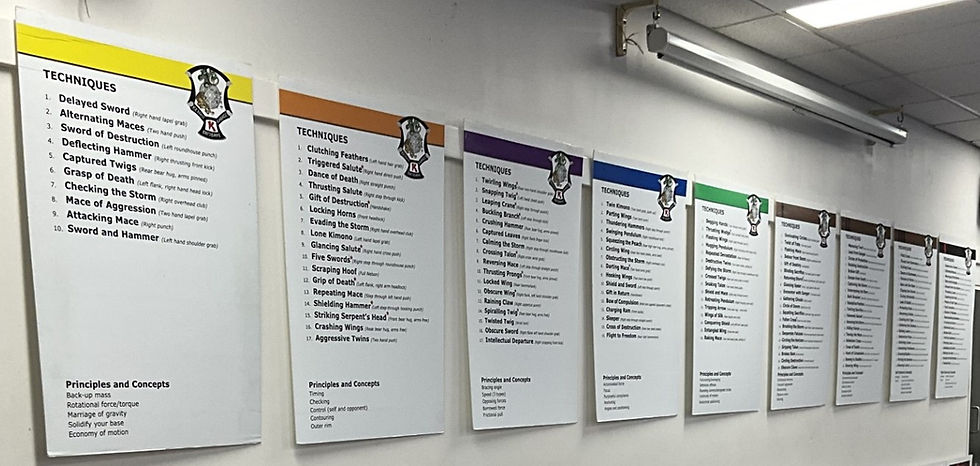
One of the more daunting things when you first begin training in Kenpo is looking at the technique chart on the wall. Most Kenpo schools have one somewhere. It lists 154 named self-defence techniques spread across the belts.
When you are still trying to remember which foot moves first in Delayed Sword, looking at a list of 154 techniques can make the road ahead seem very long.
Then, at some point, you discover that the 154 techniques are not necessarily the end of it. Many of them have extensions containing additional movements and information. Whether those extensions are taught, and when they are taught, will depend upon the particular Kenpo lineage and school.
The obvious question is: why does Kenpo need so many techniques?
Kenpo is dealing with more than a fight
The first answer is that the Kenpo self-defence curriculum is not designed solely for a contest against one person standing in front of you.
There is a difference between fighting and self-defence. In a fight or sparring match, both people have generally agreed to participate. You know where the other person is, you know roughly when it will begin and you are both trying to win.
If that were the only problem Kenpo was attempting to solve, the curriculum could be considerably smaller. A good jab, cross, thigh kick and front kick, together with the ability to combine them effectively, will take someone a long way in sparring or fighting.
Self-defence presents a much broader problem.
An assault may begin with someone grabbing your clothing or wrist. You may be pushed, punched or kicked. Someone may attempt to tackle, restrain, choke or lock you. The attack might involve a club, knife or firearm. It may come from the front, side or rear, and it may involve more than one assailant.
The Kenpo curriculum therefore progresses through a hierarchy of attacks involving grabs, pushes, punches, kicks, hugs and holds, locks and chokes, weapons and attacks by two people.
Those attacks also occur at different ranges and from different positions. A response that makes sense against a punch from the front may not be available when someone has grabbed you from behind. A technique that works when you have space to move may not work when you are against a wall or trapped between two people.
Part of the reason Kenpo has so many techniques is simply that it is examining many different problems.
Each technique is a lesson
The second answer is that a Kenpo technique is not only teaching you how to respond to the attack written beside its name.
The attack provides the starting point, but the technique contains lessons about much more than that. It may teach you how to move off the line of attack, establish a base, control the assailant's height, width or depth, select an appropriate weapon, find an available target or use one movement to set up the next.
It may teach you how to check one limb while striking with the other, how to move from one range to another or how to place yourself where you can continue while making it harder for the assailant to respond.
This is why two techniques against apparently similar attacks may still be different. They may be teaching different lessons.
One technique might emphasise moving to the outside of an attack, while another takes you inside. One may concentrate on controlling the assailant's arm, while another is more concerned with disrupting their balance. One may finish at long range, while another brings you into elbow or knee range.
The purpose is not necessarily to decide that one technique is the correct answer and the others are wrong. The techniques allow you to examine the consequences of different positions, movements and tactical decisions.
The ideal phase is not the assault
Kenpo techniques are usually first taught under controlled conditions. The attacker stands in an agreed position and delivers an agreed attack. The defender knows what is coming and performs the prescribed sequence.
That is necessary for learning. It allows the student to concentrate on stance, alignment, timing, targets and the relationship between the movements.
But it is important not to confuse that learning method with what an actual assault will look like.
The named technique presents an ideal version of the problem. The attacker behaves in a reasonably predictable way so that the student can learn the lesson contained in the sequence. Real attackers do not necessarily stand in the correct place, attack with the correct hand or react in the manner the technique appears to expect.
That does not make the technique irrelevant. It means the technique is a structured exercise rather than a promise that an assault will unfold in exactly that order.
The larger curriculum exposes the student to many different attacks and many different positions. It provides examples of what can happen and teaches ways of moving safely and effectively through those situations.
More than 154 answers
So the conventional answer to the question is that Kenpo has 154 techniques because self-defence involves a wide variety of possible attacks, and because each technique teaches more than a simple defence against the attack used to begin it.
That answer is correct, but I do not think it is complete.
If the techniques were really 154 separate responses that we had to remember, identify and consciously choose between during an assault, the size of the system would create a serious problem. The more choices we have to consider, the longer it can take to make a decision.
An assault does not provide the time to search mentally through a technique chart.
The deeper value of the Kenpo curriculum is not found in remembering an ever-growing number of separate answers. It is found in recognising what repeats across those answers.


Comments